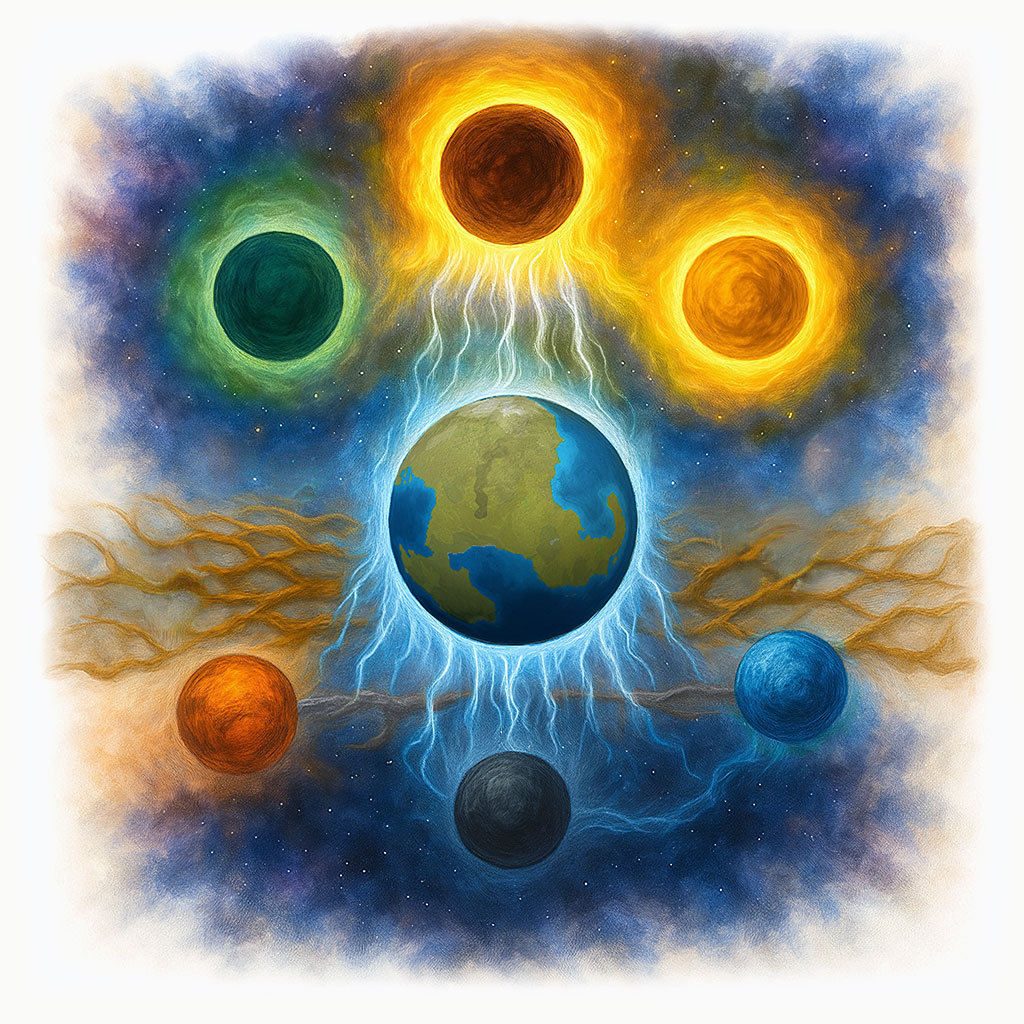
A schematic of the planar structure of the world.
Above – the three shining planes of the gods.
In the centre – the boundless material plane, tangled in “roots”.
Below – the three planes of the Abyss.
The structure of the planes is a way of picturing the cosmology. Planes are separate dimensions and reflections of reality.
Each plane is a universe of its own, with its own physical laws, its own sources of magic and its own peculiarities. All of these planes taken together are called the “Known Universe”, or the “World of Roots“. With rare exceptions it is possible to travel from one plane to another, but every such crossing has its own rules, difficulties and quirks.
The planes fall into three types:
- The planes of the gods
- The material plane
- Transitional planes (interplanes)
These three types govern how the planes, and the beings who live in them, interact with one another.
Each plane of the gods, for instance, may resemble another divine plane closely, while differing radically in law and structure from any material or transitional plane.
The upper plane – the plane of the deities, EtanDorspItii
This is where the Eternal gods live, who rule everything in the material planes. There are lesser gods here too, who serve the Eternals. Some serve only themselves. They dwell in the planes of Dorspitii (there are two: the plane of the angels and the plane of the Varkhs, or Vaarkhs). Some of the lesser gods may visit Etan. The upper plane is made of three planes:
- The plane of the Eternal gods.
- The plane of the angels.
- The plane of the Varkhs.
The Abyss – the lower planes, home of the demons
This place is the dwelling of demons. Beings who by their nature yield nothing to the gods in might. But fate had it that, sunk in endless infighting, they let slip their chance to rule the material plane – and the gods took that role instead. The demons have not given up their ambition: they hunger to take it all back and hold the place of the gods.
In the tongue of the gods this place is called SaatalSaatanspItii.
It consists of three planes and a “string”:
- Fire – the plane of the fire demons.
- Spirit – the plane of the demons who devour souls.
- Ice – the plane of the ice demons.
Fire and Ice are bound by the “string”, yet strain to pull apart. Fire wants to cool, Ice reaches for warmth. Spirit is in motion, and as it brushes the “string” it sets it trembling. Those disturbances keep Fire and Ice from merging. That is what rouses the demons living in these planes, and breeds in them the thought of becoming gods themselves.
Were there no such “string”, and were Spirit at rest, the worlds of gods and demons would be symmetrical, mirror images of one another. The reason for the broken balance most likely lies in the deeds of an Eternal god once great and long since forgotten. It was he who made this anomaly – and in doing so threw the decisive card onto the gods’ side of their age-old struggle with the demons.
The material planes – the planes of living creatures, RilmodOri (the seeds, or children, of the gods)
This is an endless multitude of worlds for living creatures. The worlds are infinite in number. Each world is a planet. Planets turn around stars. The stars stand at vast distances from one another. It is a fairly familiar and understandable description of a world.
This is the plane where every living creature lives. These worlds have ordinary physical laws, comprehensible sources of magic and the rest of it.
Forsaken / Severed worlds
Some material worlds have been torn out of the roots and/or cut off from the threads.
- With no roots, those material planes lie beyond the reach of the Ancients.
- With no threads, those worlds lie beyond the reach of the gods.
Examples: the worlds of the pseudo-god Pom, the worlds of the high-technology Aino races, the worlds of the Devourers and so on. (Each of these is cut off from a different set of things.)
The Void
The regions between the material planes and the planes of the gods, and likewise between the material planes and the Abyss. Beings live here no less mighty than the gods, and at times mightier still. They are able to destroy material worlds, tearing them out of the system of roots and threads.
They are called the Voids, or the Keepers. They did not make this world – they only watch it. Wardens beyond understanding, impartial and ancient.
Those capable of unmaking creation itself are, in truth, no more than the instruments of a will that stands higher still…
The Roots
These are the weavings of the material planes into one another. The Roots bind together an infinite number of material worlds. In the space the roots run through, the distances familiar to the material world lose their meaning. They are the inseparable companion of matter turned inside out. For a being able to travel the roots, an infinite world stops being infinite.
Here live the mighty Ancients. They watch over the wholeness of the roots and, through it, over the stability of the whole material world. They are its wardens, the keepers of the balance.
The Threads
This is a structure spun from the fabric of the material world by the Eternal god Iniax. It is the link between the material planes and the planes of the gods and demons. Iniax made it while he was still a demon himself. It is what let him reach the upper planes and become an Eternal god. Today, though, the threads play the opposite role: they have become the one easy road by which demons can reach the plane of the gods.
This is what is called the Labyrinth of the Gods. (Not every world has a “labyrinth”, but every one of them is founded or built upon a thread.)