
The basics
Races: Goblins (90%), trolls (4%), orcs (4%), others (<2%)
Languages: Common (<20%), Goblons (90%), plus assorted dialects of Goblons, Orcish and Trollish.
How power works: Family.
Power passes along the bloodline or through marriage.
Tradition is sacred and unbreakable. At present the goblin kingdom is ruled by Ebnord the Peacemaker, leader of the Brotherhood of the Grey Troll. The lands within the kingdom are governed by his sons, Marras and Grubbones. The high shaman-priest and head of the church is the king’s brother, known as the Wandering Raven.
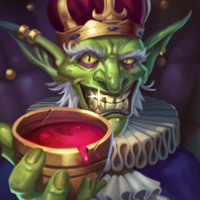
“Only men are capable of shedding blood for peace on earth.”
Colours: Red is held in particular honour. The rest carry no special meaning.
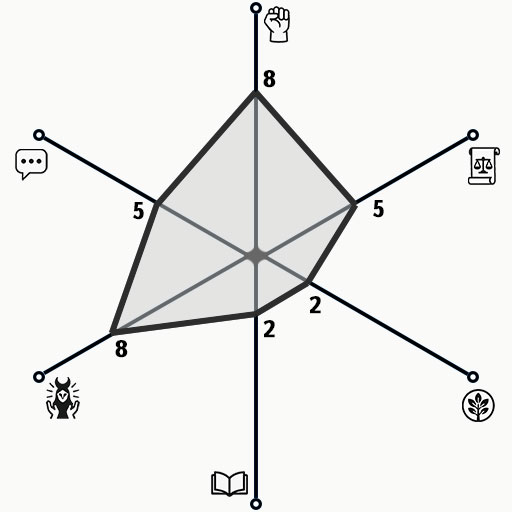

Strength: 8
Strength is the foundation of how they see the world. Physical might, power, the ability to destroy. Cunning counts as a form of strength too – especially among goblins, who are outmatched in muscle by other races.
What they prize in strength: control, power, the ideal of the soldier’s shape.

Order: 5
Order is taken loosely. Common goblins lean towards chaos and see no value in things being orderly. The upper class, however, tries to impose order by force, holding it useful for everyone else and not applying it to themselves.
What they prize in order: the tie to ancestors and to the past.

Nature: 2
Nature to them is a resource, and not the most valuable one at that. They feel no love or awe for animals or for the world around them.

Knowledge: 2
They are indifferent to knowledge. Partly because they do not see the use of it, partly because of hostility from their rulers, who consider learning harmful.

Religion: 8
Religion is the single most important element of goblin society. It underpins their cohesion, and the crown supports and enforces it energetically. It is no accident that the High Priest is the king’s closest kin.
What they worship above all is fire, as a symbol of strength. Sacrifices are frequent, goblins among them. Fire and blood magic are the most widespread; mages of other schools are hunted down.
As gods they worship assorted demons and one Eternal god – Yal-an Galyn, Lord of the Eternal Fire.
Goblin speech has its quirks: the sound “ya” is hard for them, and in place of “i” they say “o”. So in their mouths the god’s name comes out differently – Al-an Galon.

Communication: 5
Goblins like to talk. The upper class keeps to an elaborate, formal etiquette. Conversation and cohesion are considered vital for survival and for keeping power.
The goblin capital
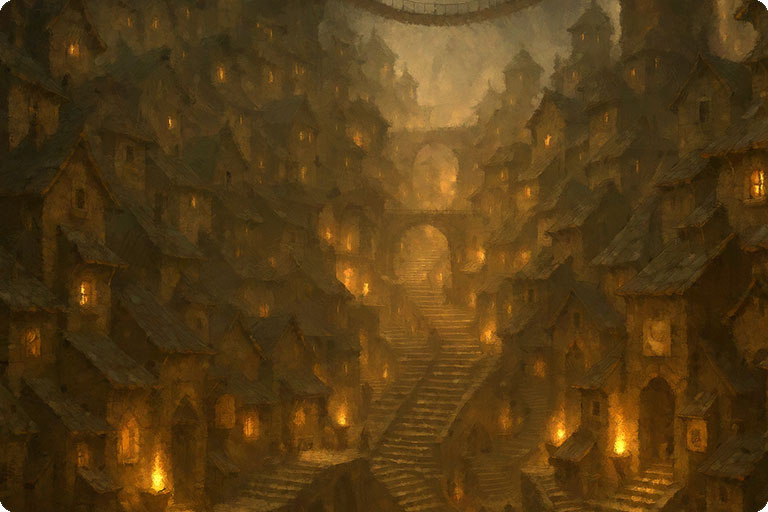
An enormous underground city hewn out of the roots of a mountain – as most goblin cities are. Here you will find:
- The high church.
- The king’s residence.
- The goblin military institutions. Two matter especially:
- The House of the Troll – the training grounds of the royal trolls, the monarch’s personal guard.
- The Temple of Warriors – the legendary goblin school of martial arts, famous far beyond the kingdom.
- The powder manufactory – the one place where science is respected. Here goblin alchemists develop fire-based weapons.
- The teleportation gates, for travel over long distances.
Population: about 50,000.
What the city is like
The city runs deep. It is made of many levels and of stairways leading further and further down. Its architecture is one of wide halls, stone arches and broad staircases.
The city is hidden from sunlight, so torches and lanterns are everywhere. The constant crackle of fire, the dancing shadows, the smell of burnt fat and soot make up its particular atmosphere.
There are plenty of taverns, shops and forges. The services of mages, alchemists and priests, though, are rare.
Law and order:
Kept by the goblin watch – veterans of the army.
Economy:
Built on mining ore and smelting it. Goblins cannot work hard metals on an industrial scale.
Copper and iron are common and cheap.
Mithril and adamantine are mined as ore and sold to other kingdoms.
Gemstones are mined as well.
Supply:
Food and water are produced in the city.
Water comes down from the mountains along purpose-built channels, from the ice caps into reservoirs.
Food is grown on the spot – goblins raise underground crops, mushrooms above all. Meat from the surface is a rare delicacy. Fish are bred in underground pools.
Water – plentiful.
Grain – scarce, a delicacy.
Meat – imported, a delicacy.
Fish – from underground.
Odds and ends. Two of the mushrooms the goblins grow are worth singling out:
Plimb – a blue mushroom, the staple food, rather like honey fungus.
Kirompl – a red mushroom high in sugar, used for brewing alcohol.
Goblin money
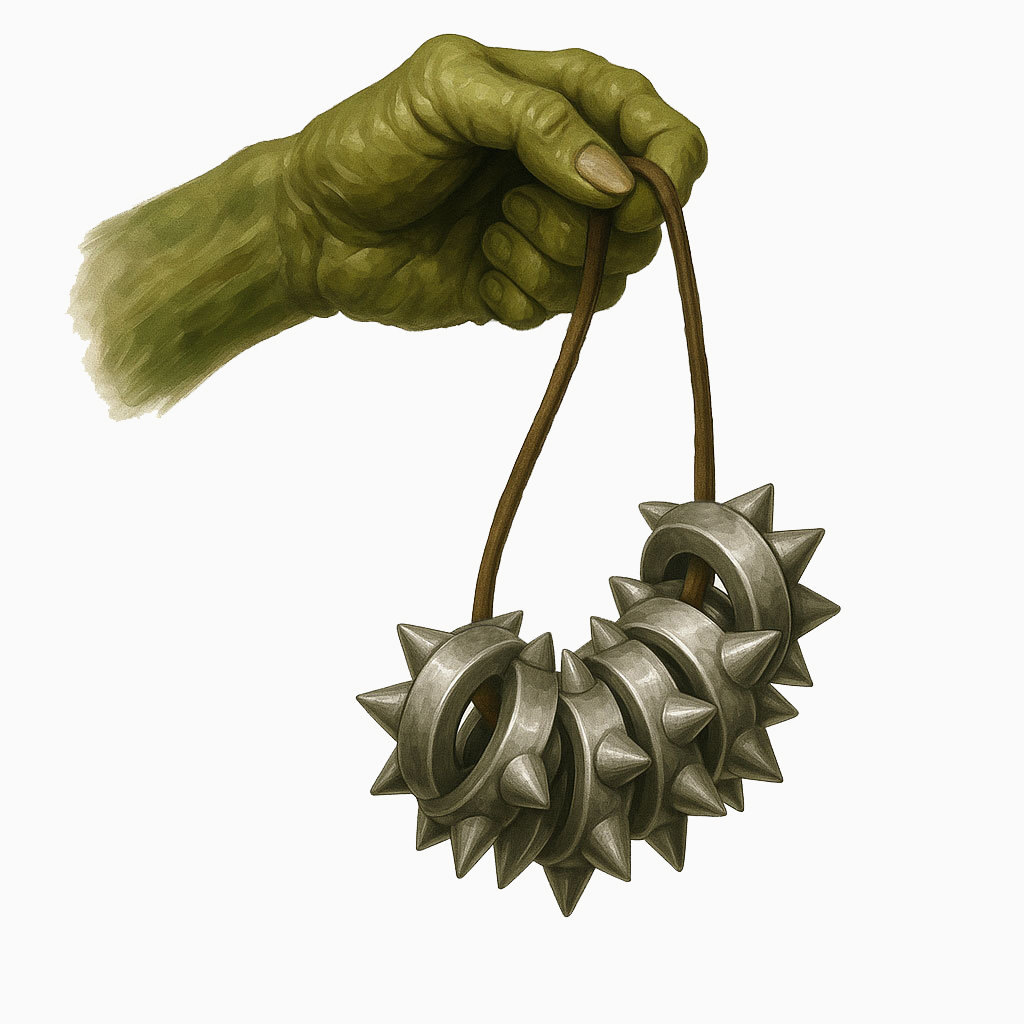
Goblins use a silver coin – the Santim of Ebnord. It is studded with spikes, has jagged edges and a hole in the centre.
The coins are threaded onto ropes or leather cords and worn as necklaces. At a pinch such a string can be used as a weapon.
1 S.E. = 1 silver piece.
Smaller goblin settlements
Smaller goblin settlements – khatso – differ in the following ways:
- The buildings are mostly wooden.
- The further from the capital, the weaker the crown’s grip. Some settlements are subject to punitive raids.
- No magical services whatsoever.
- No teleportation gates.
- Local chieftains may pursue private aims, sometimes at the kingdom’s expense.