The basics
Races: Elves (>90%), though the mix varies from city to city.
Languages: Elvish / Gunkhar
How power works: Companies / Orders.
The faction is a union of elven city-states, each of which is in effect an independent corporation. Every city has its own leader, and the way that leader is chosen differs from place to place. Populations range from 1,000 to 100,000.
Well-known and influential leaders:
– Ardrill the Grovekeeper / Helegthul Imlad
– Gildala Zaufan / Yalun Dar
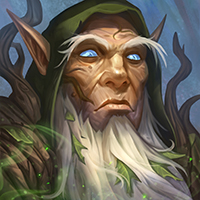
“The strength of the sword is fleeting, like a thunderstorm, but the strength of the forest is everlasting. The roots of the trees remember who was a friend and who simply turned to ash.”
Colours: Green – the symbol of life. Violet – the colour of wisdom.
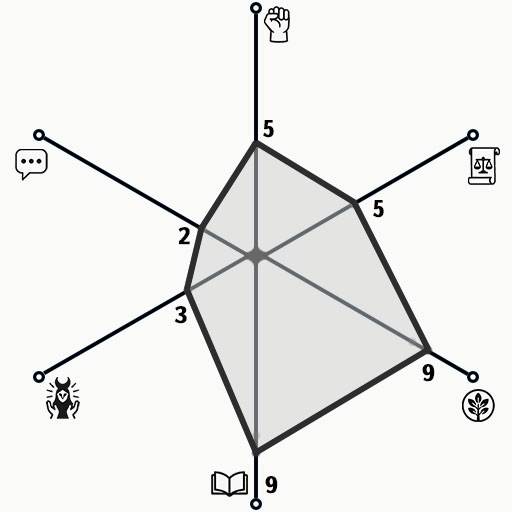

Strength: 5
For elves the idea of strength has many faces: it may be physical, intellectual, cultural or magical. Every form of strength is acknowledged, so long as it is shown with moderation. Aggression, on the other hand, does not count as strength at all – quite the reverse, it reads as a mark of savagery and ignorance.
What they prize in strength: the possibilities it opens up.

Order: 5
Laws, customs and traditions differ sharply between cities, and at times contradict one another. Order is therefore not held to be a key value of the faction as a whole. Within any one city, however, local law is usually kept strictly, and the inhabitants treat it with respect.
What they prize in order: the clarity and fairness that law brings.

Nature: 9
Nature is the cornerstone of their culture. Reverence for the natural world, be it green forest or gloomy cave, is the foundation of life. The same respect extends to animals – from noble beasts to repulsive insects.
That respect for nature often takes forms close to a religious cult. Whatever their habitat, elves strive to live in harmony with the world around them, holding nature to be their chief ally.
What they prize in nature: nature is life itself.

Knowledge: 9
Knowledge is the elves’ second pillar after nature. If nature gives life, knowledge gives strength. They value knowledge of every kind: scientific, magical, medical. Knowledge bound up with nature is honoured most of all. Technical disciplines such as engineering or mathematics are barely studied.
Elves strive to grasp knowledge and to preserve it, and treat it with care.
What they prize in knowledge: the chance to build a future.

Religion: 3
Their pragmatic turn of mind keeps religion from playing any great part in society. Yet their deep love of nature and of knowledge breeds a multitude of schools and cults whose forms of reverence and ritual can look much like religious practice. These are treated with respect, but they are not a defining force.
Among the Gunkhars the cult of “Iran Zath Shi” – the House of the Great Spiders – is widespread. It is a blanket name for the worship of underground insects, and of spiders above all. The structure of the cult varies, branching into many forms.
Its chief deity is Zath Ilztran, an elf who by legend became an Eternal god through his study of the dwellers of the caves and of their poisons. His knowledge grew so deep that it raised him up. Beside him, worship also goes to his avatars and to members of his retinue: Keks, Wurm’Talek, Zhrak’Kzul, Ksir’Mogrash and Tal’Zureks. Individual dwellers of the depths of Vail Zurra may be taken as objects of worship as well.

Communication: 2
Elves keep to no elaborate etiquette and have no taste for ornate forms of address. Intrigue, conspiracy and gossip are no part of their cultural norms and are not practised for amusement. If the situation calls for them, though, they can be used with cold calculation – purely as a means to an end. Elven society is closed, reserved, and often mistrustful of outsiders to the point of open xenophobia.
Economy and production
The cities specialise in different industries, producing everything they need for themselves, from food to weapons. Whatever they turn out especially well becomes an export. Each city-faction is therefore, in effect, a corporation with a specialisation of its own.
Worth noting: there are military corporations that export mercenaries. Many cities use them as their main armed force.
Elven money
The common currency is the Milliem of Ardrill: a gold coin inlaid with emerald and sapphires.
1 M.A. = 100 gold pieces, and can be broken into 5 parts – Dins.
For everyday needs there is a small coin – the Chukhai.
1 Ch. = 1 silver piece.
Helegthul Imlad
Head: Ardrill the Grovekeeper
Industry: Military corporation
Assets: A strong leader, a spotless reputation and popularity
Weakness: Financial debt, the devaluing of its services
Vice: Harm to clients, internal corruption
Best known for:
- Product: Warriors – the finest elven fighters
- Services: Protection, escort, keeping order
- Tragedy: “Rodom…”
The largest and most respected supplier of armed force and weapons among the elves. It provides not only fighters but policing functions too, protection and the stabilising of order among them.
If there is a war, they are hired. If order is wanted, they are hired again.
For this corporation, reputation is everything. It is both the source of their influence and their weak point. Keeping it up often means spending more resources, making concessions, or even taking on debt. It is especially hard when competitors offer similar services for less.
Hidden corruption is ripening at the top of the organisation. Some commanders in the field abuse the trust placed in them, reaching for power of their own. Such cases have to be hushed up to keep the prestige from slipping.
The phrase “Rodom…”, or “just like in Rodomhul”, became a hint at an old tragedy. A commander of the corporation, hired once to guard the city of Rodomhul, secretly seized power there, removed the local rulers and set a puppet of his own on the throne. Nothing was ever proved, but the rumours soiled the organisation’s reputation. To bring it up in front of a representative of the corporation is a grave insult.
Many inside the organisation hold that the problem was not the deed but the fact that it got out. Behind closed doors the commanders go on dreaming of power over those they “protect”. That makes fertile ground for competition – new military corporations are slowly winning the market away.
In the middle management there is constant rotation of staff, which prevents influence from concentrating and cuts corruption schemes short.
The city
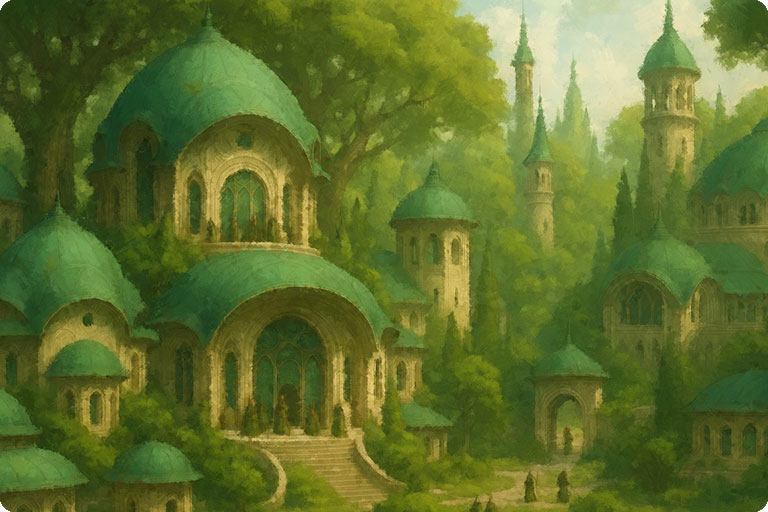
Helegthul Imlad is the largest, wealthiest and best-defended elven city on the surface. Here you will find:
- The Palace of the Governor’s Council.
- The warrior school “The Green Falcons” – the main army school.
- The warrior school “The Wanderers” – the finest school of archers in the world.
- The library-academy “Imlad Ba Har”.
- The teleportation gates, for travel over long distances.
Population: about 50,000.
What the city is like
Its architecture is unlike anywhere else: buildings without sharp corners, shaped in ovals and circles. The roofs and domes are green. Everything in the city calls to mind giant trees – as though the forest itself had turned to stone.
The city drowns in greenery: gardens, groves and parks run through the streets. Here stand all the corporation’s administrative offices, the diplomatic embassies of the other city-states, and a great many training grounds.
Helegthul Imlad is also the centre of elven learning. The largest library-academy is here.
Supply:
Food and resources are imported into the city, but the supply lines are impeccable. Every inhabitant has means enough to live in comfort and safety.
Water – imported, plentiful.
Grain – imported, plentiful.
Meat – imported, plentiful.
Fish – imported, plentiful.
Yalun Dar
Head: Gildala Zaufan
Industry: Mining / Alchemy
Assets: Enormous revenue
Weakness: An incompetent leader, the risk of losing what makes its products unique
Vice: Harm to clients, incompetent staff
Best known for:
- Product: Gemstones and ores, artifacts from the depths, narcotic substances
- Services: Alchemy
- Tragedy: Too close a tie to strange religious cults, and drugs.
The corporation is the largest in the world at extracting anything that can be found in the depths of the mountains. From ores and gemstones to the artifacts of ancient civilisations. Alchemy is very highly developed here (thanks to the unique plants of the deep).
Alchemy is the largest source of income, on the back of exporting unique narcotic substances.
Their wealth lets them keep an army of their own.
Producing narcotics is an internal problem, since a great many workers of every rank are addicted, or “strange”. Hence the religious fervour for the cults of “Iran Zath Shi”, which is not at all typical of elves.
The head of the corporation is a little mad and badly obsessed with the cult. She often makes decisions that make no business sense.
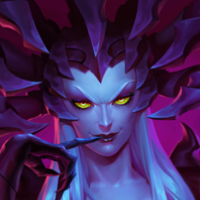
“The spider weaves a web, and I weave fates… “
The city
Yalun Dar is the largest city in the world and the most populous among the elves. It lies deep in the roots of a mountain and has no clear boundary between outskirts and centre. There is no direct entrance: the way runs through a net of narrow, multi-level tunnels that are all but impossible to pass without a Gunkhar guide. Slipping through unseen is out of the question altogether.
On the surface, at the foot of the mountain, there are small settlements. Travellers can rest there, hire a guide, or wait for the city’s representatives.
Diplomats and major traders do not use the tunnels – they travel by portal. Yalun Dar’s portal network is the largest in the world, connecting the city with any corner of the planet.
- The Governor’s Palace.
- The portal hub “Shi Ma Zath” – the largest portal junction in the world, with taverns, shops and all the rest of the infrastructure. The name translates from Gunkhar as “The spider’s legs that enmesh the world”.
- The Temple of Spiders – the chief temple of the Eternal god Zath Ilztran.
- The alchemical academy “Mo Zath” (“The Spider’s Elixir”) – a school of alchemy, an academy and a network of manufactories in one.
Population: about 200,000.
What the city is like
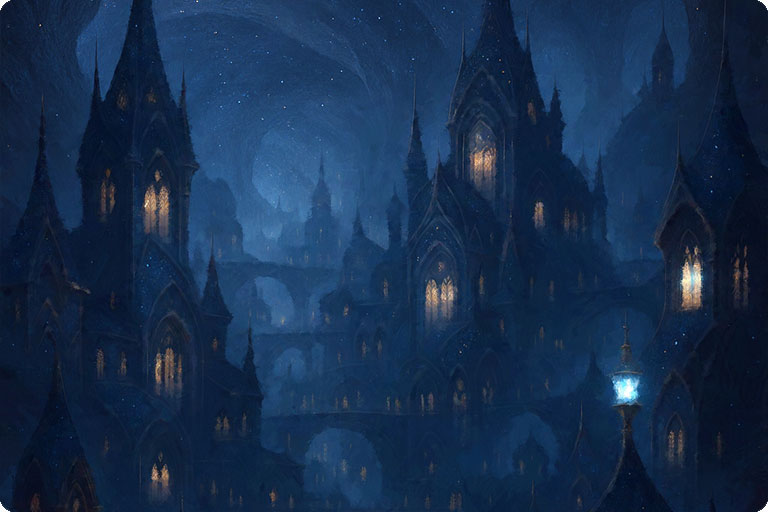
Beneath the city runs a net of tunnels and caves reaching far beyond the Spider Mountain. Some of them are thousands of kilometres long.
The city sits between 3 and 10 km below the surface. Below that the mines and deep tunnels begin, reaching down to 30 km. Here run long horizontal passages that girdle the planet. Now and then they open out into enormous “halls” – voids up to tens of kilometres across and hundreds of metres, or even kilometres, high.
The Gunkhar names:
The whole network – Vail Zurra (“the Dark Weave”)
The vertical shafts – Mirz-Kellot (“the Ant Pipe”)
The deep horizontal tunnels – Lidts-Allarin (“the Dark Roads”)
The halls and oases – Zaal-Ktarris or Kharron-Ktarris. The translation depends on who lives there and what grows there. These names come out roughly as “great underground spaces that take your breath away when you step into them”, or more plainly as “the lair of beasts”.
What the inhabitants do for a living:
Farmers – grow underground crops and breed insects, from small ones (about the size of a shrimp) to large ones (about the size of a dog).
Miners – extract ores and metals.
Seekers – gather the rarest plants, mushrooms, berries and insects from the furthest tunnels and halls. It is they who supply the alchemical industry with the raw material for narcotics.
Supply:
Water – plentiful.
Grain – plentiful (underground).
Meat – insects plentiful (animal meat imported/a delicacy).
Fish – imported/a delicacy.
Odds and ends. Two of the plants the Gunkhars grow are worth singling out:
Underground rice – a cereal crop that grows in flooded tunnels.
Deepleaf – a nourishing underground grass.
Well-known drugs:
Fairy sugar – the commonest drug, it turns the eyes blue.
Brezlov – a military stimulant made for Helegthul Imlad; it turns the eyes green.