Domain: Destruction, growth, storms
Power
The reach of the god’s dominion.
- 1A lord of small things: a single tree, a single pack, a single song. His blessings are modest, and often he himself serves a far greater power.
- 2His will extends over a city or a forest. Within his domain he is mighty, yet he keeps a wary eye on those who are stronger.
- 3Broad lands and great elements – wind, sea – are his to command. His power reaches beyond his domain: he works miracles and creates artifacts.
- 4His might spans whole worlds. He rewrites the laws of his domain, bends nature to his will and grants mortals power equal to that of the lesser gods.
- 5His power is woven into the very fabric of existence. He reshapes reality, creates universes and new gods; his dominion is all but boundless.
Interest
Where the god’s gaze is turned: to the heavens or to the mortal world.
- 1His gaze is turned to the heavens alone. The mortal world is nothing to him, even his own faithful and their souls. He is absorbed in his domain and in the deeds of other gods.
- 2He descends to mortals only out of need – when through them he can strike at an ally or a rival. He is not drawn to them himself.
- 3He keeps the balance between heaven and earth. Worshippers are a mark of his greatness, the things of his domain are his possessions, but he weaves his designs among the gods.
- 4The mortal world is dearer to him than the heavens. He remembers the gods only when they touch his earthly affairs, and he often appears to his faithful himself.
- 5He lives for the affairs of mortals: he watches, intervenes, judges – always in person. The quarrels of the gods barely touch him, even when they concern mortals.
Passion
The strength of the god’s feelings and will.
- 1Dispassionate as stone. He meets a gift and an insult alike; even his own domain seems not to move him.
- 2Few things are sacred to him, and all else is a matter of indifference. Only one who knows his nature can stir him to act.
- 3Like most gods, he seems capricious to mortals: his passions flare and fade with the strength of his domain.
- 4Guarding his domain is not enough for him – he longs to expand and remake it. Hence the intrigues, feuds and sacrifices.
- 5A storm of feelings and desires. For a whim he will reshape the world at any cost, and his impulses are beyond mortal understanding.
Thought
How far a mortal can understand the god.
- 1Unfathomable. His deeds seem random, contradictory or too complex; it is hard to say whether he thinks at all.
- 2Understood only in broad strokes, and even then by those versed in his domain. His decisions baffle even devoted priests.
- 3He thinks like a beast: crudely or strangely, but it is clear what drives him.
- 4He thinks like a reasoning mortal, but with marked oddities – a morbid love of etiquette or a weakness for flattery. He can be understood, and yet something about him is not right.
- 5He thinks exactly like a human. Only the burden of ruling a domain sets him apart from a mortal.
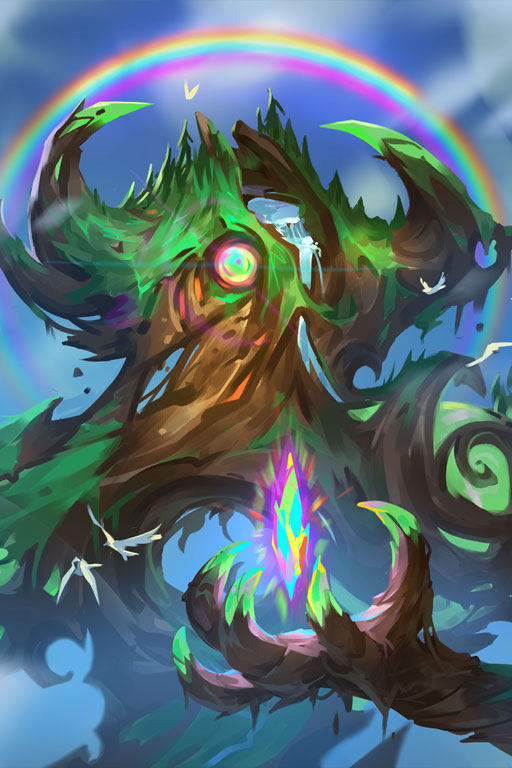
Maro was one of the Ancients – the guardians who watch over the Roots and the balance between worlds. Having become an Eternal, he did not lose his bond with the Roots and senses every world. Maro sleeps, and the nature of the worlds is his dream. What wakes him is the wound of a whole world: a world torn from the Roots, a world invaded by demons reaping a harvest of souls. Such a dream can no longer be saved, and on waking Maro erases that world together with everything he dreamed in it. The unheard-of storm leaves nothing behind, a rainbow rises after it – and the world comes to life again.
Heralds of the god – the Ancients, flocks of birds, wolf packs
How does the god deal with mortals? – He does not address them himself; shamans hear his roar in the wind and read natural disasters as his wrath
How does the god spend his time? – He sleeps in the eternal storm-forest in Etan, where storms and new forms of elemental life are born
Objects tied to the god – rainbow crystals, tree branches, totems of stone and leaves
How does the god wish to be worshipped? – With offerings of the fruits of the earth, dances in thunderstorms, the planting of sacred groves, and storm totems
Followers – Nibirion (the universe)
Loyalty
How sincerely and how unanimously the god is revered.
- 1The god’s name lives only in tales and jokes: he is loved, but not worshipped.
- 2Scholars remember him, but no one prays to him.
- 3His name and power are used for gain, not out of faith.
- 4He is prayed to, but much of the teaching is forgotten, and his will is argued over endlessly.on Nibirion
- 5The faith has split into sects, and each interprets the god’s will in its own way.
- 6The faith has a church with a hierarchy and temples, though politics sometimes distorts the teaching.
- 7Almost every believer is sincerely devoted to the god and his domain.
- 8Among the faithful there are fanatics ready to die for their god.
- 9The believers have given the god their will – they have almost none of their own left.
- 10Every deed of a believer is a prayer; service has become their nature.across the universe
Influence
What the faith is able to do in the world.
- 1To confess this faith is to lose the respect of mortals and gods alike. The believers hide.
- 2All the flock can do is protest.
- 3The faith exists, but mostly in words; it struggles to achieve even small things.on Nibirion
- 4The believers have no shared wealth – only their own hands.
- 5The faith builds temples, gathers communities and prays unhindered.
- 6The church can support its own anywhere – from a common treasury or through the generosity of wealthy believers.
- 7The faith is a major political force: grand temples, wars of faith, the defence of the god’s domains.
- 8The faith rules the culture of whole nations and commands their wealth.
- 9Other churches and even lesser gods swear fealty to it.
- 10Almost all gods and mortals follow it in one way or another.across the universe
Size
How many followers the god has.
- 1The church is only an idea; the god still awaits his first believers.
- 2The god has a single follower, and all the god’s mortal affairs rest on that one.
- 3A small handful of the devoted.
- 4A few small communities within a single region.on Nibirion
- 5Several communities in different lands.
- 6There would be enough believers to fill a small state.
- 7There would be enough believers to populate a great empire.
- 8He is revered almost everywhere in the mortal world, even if this is not acknowledged.
- 9In the heavens his cult is more visible than among mortals.
- 10Every being in every world reveres him in one way or another.across the universe
On Nibirion Maro is barely known: only the gnolls, among their small cults of nature and swamps, occasionally revere him too. They take his storm for punishment for a felled grove, and so a sacred grove is not found but planted, and every tree in it is an oath. The gnolls take the rainbow after a storm as a sign that his wrath is appeased, though no storm over their swamps would be worth waking him.
Relations
- Zath Izlatran perverts the order of creation with his spawn. (-8)
- Mogoi amuses me; with him my storms are merrier. (+9)
- Ullr Mooshii is a fool: he locks in ice what ought to be erased. (-5)