
Sega Mega Drive / Genesis
Three rogues, one grumpy dwarf and an entire city that should have stayed sealed..
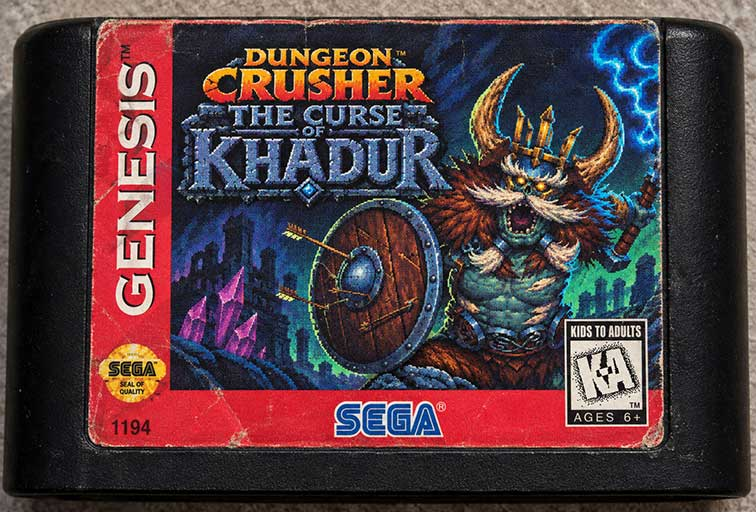
The Mega Drive was never short of isometric adventures – Landstalker and Treasure’s Light Crusader both made a decent fist of the viewpoint – but very few of them tried to marry it with the slow, deliberate, room-by-room dread of The Immortal. Curse of Khadur does exactly that, and then throws a dash of The Lost Vikings into the mix for good measure. On paper it sounds like a recipe for a mess; in practice it’s one of the more interesting RPG curios to grace Sega’s 16-bit machine.
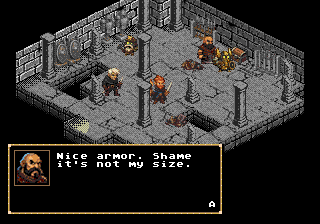
You control a trio of hired adventurers: Garrick the bard, Grisvold the warrior and Needs, a thief whose name tells you everything you need to know about his moral compass. They’ve been summoned to Khadur, an ancient dwarven city carved into the rock and sealed away from the world for centuries, by a dwarf named Grimbolts – who, it transpires, isn’t entirely blameless for the fact that the place is now crawling with the dead. His request is simple enough: recover the three relics of the Phoenix, lost somewhere in the depths, so that he can put things right. Grimbolts speaks in a thick brogue (“Och, ’tis nae hard”) that wouldn’t sound out of place in a Glasgow pub, and it’s hard not to smile every time he promises your reward “after”.
The big twist is that your heroes don’t travel as a party. Each one stands in his own spot in the world, and pressing START brings up a menu that lets you swap between them – even if that means jumping to a completely different floor of the city. Each has a talent the others lack: Needs can pick locks and sniff out hidden passages, Garrick can talk his way into conversations that would otherwise be closed to him, and Grisvold… well, Grisvold hits things, and occasionally turns into a bear while doing so. The result is that many rooms are less about “can I get through here?” and more about “who should I have brought here in the first place?” It’s a clever idea, and when it clicks it’s genuinely satisfying.
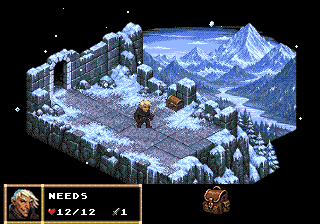
Movement is strictly tile-based, which may disappoint those hoping for Landstalker-style freedom, but it’s a sensible decision. Anyone who has wrestled with a diagonal jump on a three-button pad will know that isometric views and precise control rarely go hand in hand, and Khadur neatly sidesteps the problem – there’s no jumping at all, and no falling off ledges because the camera lied to you. That’s not to say the city is safe: collapsing floors will happily dump you somewhere unfamiliar (and knock a few hit points off in the process), and the moans of “Oof! I nearly broke my neck” soon become a familiar refrain.
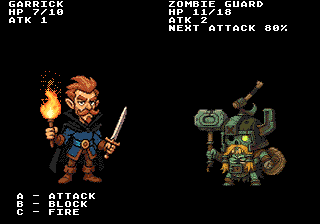
Combat takes place on a separate screen with large, detailed portraits of the combatants, and it’s here that Khadur really surprises. Rather than the usual Fight/Magic/Run menu, each character draws from a personal deck of moves, and every round you’re offered three of them, mapped to A, B and C. Attack, Block, Parry, Dodge, a devastating Smash if you’re lucky – once a card is played it leaves the deck until it reshuffles, so you’re constantly weighing up whether to spend your best move now or save it. Better still, the game tells you what the enemy is probably going to do, along with a percentage. Weak shambling zombies are fairly honest about their intentions; tougher foes are considerably less so, and learning when to trust the hint is half the fun. It’s a small system, but it’s a remarkably smart one for a cartridge of this vintage.
Death isn’t the end, either – at least not immediately. A fallen hero leaves a body behind, and one of his companions has to haul it back to a very unlikely source of help if he wants his friend back on his feet. It’s a morbidly amusing chore, and it gives each fight a sense of consequence that most console RPGs of the era simply didn’t bother with. Lose all three, however, and it’s game over.
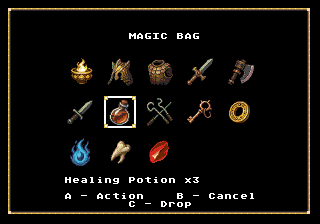
Sadly, all of this juggling does come with a cost. With three characters scattered across the city, a fair amount of your time is spent walking back and forth, and the game offers little in the way of hand-holding; the occasional nudge from your party (“Something is off about these walls”) helps, but some players will inevitably find themselves wandering the same corridors wondering what they’ve missed. Enemies can also hit surprisingly hard if you stumble into them at half health, so hoarding healing elixirs quickly becomes second nature. Those who favour Zelda-style immediacy may find the pace a little too measured.
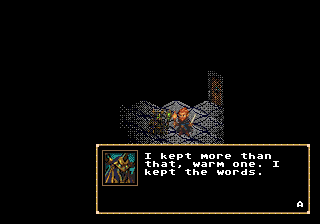
Visually, Khadur is a treat. It opts for the same restrained, ‘Western’ palette that made Light Crusader stand out, with detailed tiles and sprites that sit neatly on the isometric grid. The city itself is the real star: as you venture further in, crumbling ruins give way to grand temples, noble districts, frozen streets and bone-strewn ossuaries, each with its own distinct look, and the remains of long-dead dwarves litter the halls waiting to be searched. The sound is more atmospheric than melodic – brooding FM drones rather than hummable tunes – which suits the setting perfectly, even if the Mega Drive’s sound chip occasionally makes it sound more like a rumbling fridge than a haunted city.
Conclusion
Curse of Khadur is an odd beast: part puzzle-adventure, part card-based RPG, part logistics exercise. It won’t be to everyone’s taste – the tile-based movement and the constant shuffling between heroes demand a degree of patience that many modern players simply won’t have – but those willing to meet it halfway will find a thoughtful, atmospheric and surprisingly inventive adventure. It’s certainly unlike anything else in the Mega Drive’s RPG library, and that alone makes it worth a look.