
The basics
Races: Humans (70%), Dwarves (10%), others (20%)
Languages: Common (~30%), and a great many separate human tongues.
How power works: Empire.
The Viteron Empire has seized and forcibly subdued nearly every human people. Many states keep partial sovereignty as vassals, colonies and the like. Different territories are governed on different principles and hold different rights. The empire is a thalassocracy (with one small twist: a city with teleportation gates is, in practice, no different from a seaport, even deep inland).
The reigning emperor is Valerian. The face of the church and of ceremony is the high battle mage Taivion the Blue.
Colours:
Red – the colour of strength.
Blue – the colour of wisdom.
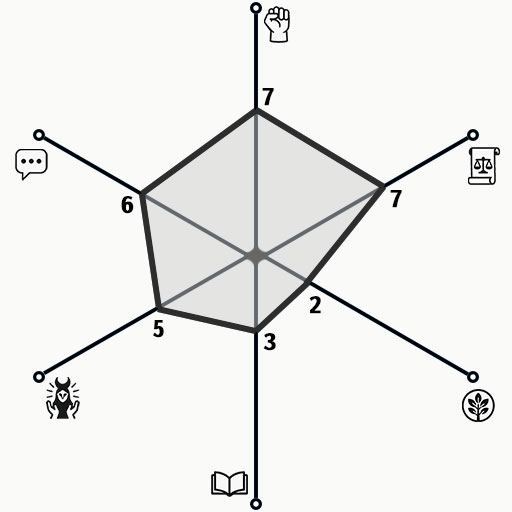

Strength: 7
“The strong rule the world, the weak serve it.”
That is roughly one of the empire’s core ideologies. Strength is seen in a positive light, in the key of aggressive expansion. It is the source of glory, of power, of wealth. A great many institutions exist to glorify it.

Order: 7
Order is the embodiment of law. Keeping the law is held to be very important, both in the empire proper and in the colonies. What matters is that the law is one and the same for everyone (though the colonies may have laws of their own as well).
What they prize in order: the settling of disputes, and standing against chaos.

Nature: 2
Nature is a resource, and nothing more. No subject of the empire will understand why you cannot fell a few trees for a night’s campfire. Or why elves might speak with contempt of a supper that cost a whole deer.

Knowledge: 3
They understand the value of knowledge and what it is good for. But they have never lifted a finger to gather, keep or advance it, and never will. It is impossible to imagine a governor of the Viteron Empire building a library in his own domain. Though he will study with curiosity the library of a newly taken city (and may even refrain from burning it afterwards).

Religion: 5
Religion matters to ordinary people, rooted first of all in superstition, tradition, ritual and explanations of the forces of nature, and in the end in an understanding of what one’s soul is worth.
At the higher levels of government religion is not used as an instrument of rule. There is no single form of “correct” belief in this or that god, and no faith in any of the Eternal gods. Faith is directed mainly at the Angels of the lower divine planes, which in turn explains why there are wizards here who draw their power from Angels.

Communication: 6
The empire has an intricate social system, close to an estate system. The higher the level, the more complex and tangled its forms become. At the summit stands the emperor, with a highly elaborate system of ceremony, etiquette and social norms. The whole complexity of that etiquette exists to underline the empire’s strength.
For example: the emperor cannot simply declare war. First a council of commanders is convened, at which the emperor names the enemy in a set form. The command is appointed at the palace. The emperor must personally give each commander his charge. A grand parade is held in the city, and from it the army marches to war.
The imperial capital
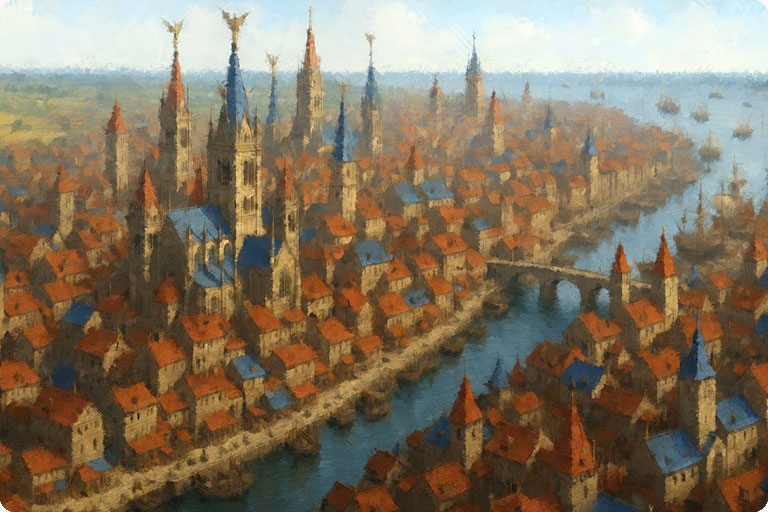
Viteron is the largest metropolis in the world.
Its population is a thoroughly mixed one, drawn from many human nations and from the races of the empire.
Here you will find:
- The emperor’s palace – the ruler’s residence and the symbol of imperial power.
- The Arch of Victories – a broad road running into the centre of the city, framed by a succession of monumental arches. One of them, especially grand, is shaped like a sword. Military and festival parades pass along it regularly.
- The Temple of Eltor – the largest religious centre of the empire, dedicated to the angel Eltor. It is the oldest building in the city, standing here before its sudden growth.
- The port – one of the great trading ports of the world. Thousands work here. Goods from across the empire flow into it.
Population: about 100,000.
What the city is like:
Viteron stands on a river with a fairly close outlet to the sea (~30 km). Historically it was ringed by thick forest, but by now almost all the land around it has been given over to farming.
The city is comparatively young beside the other great metropolises of the world. Human settlements have stood here since time out of mind, but Viteron’s history as a city barely spans a thousand years. It passed 10,000 inhabitants only some three hundred years ago.
Viteron has no shortage of taverns, inns, workshops and shops, and of temples dedicated to the divine Angels.
There are no teleportation portals in the city – the nearest are about 100 km away, in another major centre.
Law and order:
The city has its own police, unconnected with the imperial army.
Economy:
Townsfolk mostly work in farming and livestock, at the port, in services, and in the city’s administrative bodies.
Supply:
The city wants for nothing.
Water – plentiful.
Grain – plentiful.
Meat – plentiful.
Fish – plentiful.
The rest of the empire
The empire is extremely varied. Its domains take in northern lands ruled by family clans and southern ones whose system of rule can best be described as sultanates. In some districts there may be no local statehood at all, and the people may live as hunter-gatherers.
The empire controls not so much land as the sea, the trade routes and the teleportation portals, building fortress-cities to hold the key points. Inland expansion on the continent rarely runs beyond 100 km, and most of the empire’s large cities sit on the coast.
Revolts flare up regularly, and the army is in constant struggle with them.
Outward expansion is hampered by geography: to the north lie hard country under the control of Vadokan Votar; to the east, the elven city-states, with whom firm trading ties exist alongside a shared awareness that their military strength is evenly matched.