
On the devastated continent of Talelis, among endless rifts, fiery chasms and the ruins of forgotten civilizations, rises a structure that the peoples of Nibirion call the Castle of the World King. No one knows how many millennia it has stood, who raised its walls, or what secrets lie hidden in its depths.
Ancient chronicles mention the castle as the abode of a mighty sorcerer who owns countless treasures and knowledge beyond the reach of mortals. For centuries kings and conquerors sent armies to its walls, hoping to seize the riches of the mysterious lord. Yet not one of the known expeditions managed to learn the true nature of this place.
In truth, the Castle of the World King is neither a fortress nor a palace in the usual sense. It is a divine structure, created by the will of Iniaxa, the Great-Hearted, one of the Eternal gods, to watch over the world and to guard the divine realms against demonic invasion.
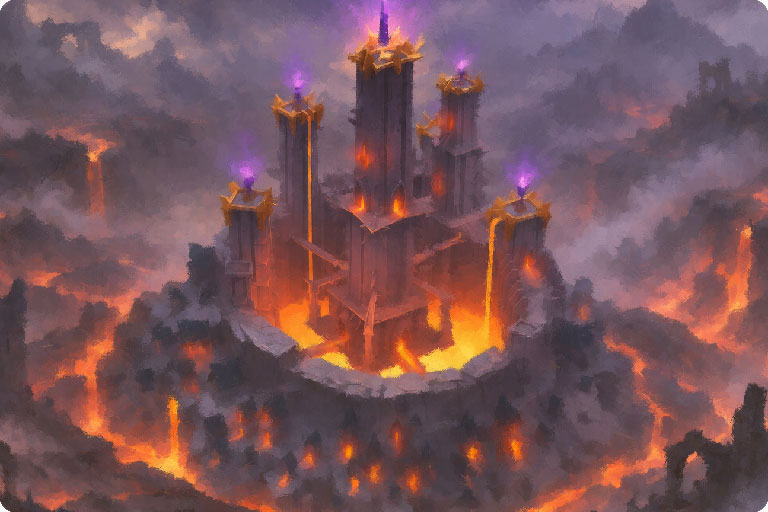
The Origin of the Castle
Iniaxa, the Great-Hearted, does not interfere directly in the fates of mortal peoples – to him these are trifles. Yet there are threats before which even mighty civilizations are powerless.
One such threat is the incursion of demons from alien planes of existence. For Iniaxa the danger lies not so much in the death of the mortal world as in the chance that the invasion could spread through this world into the abodes of the gods themselves.
When, in the judgement of the Eternal, such a threat grows great enough, he may raise a special structure in the chosen world – an anchor point of his will and power.
The Castle of the World King is exactly such a structure.
It serves as the residence of the divine viceroy, the place where the power of Iniaxa is gathered, and a means of watching over the state of the world. Its purpose is to detect the signs of demonic incursion and to counter threats capable of breaking the boundaries between worlds.
The very name “the Castle of the World King” arose among mortals. The true name of the structure, if it has one at all, is unknown.
The Black King
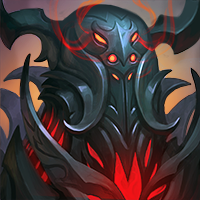
In different lands the master of the castle is called the Black King, the Dark King, the Rune King, or simply the World King.
In folk tales he appears as an immortal sorcerer, an ancient tyrant, or a being that made a pact with unknown powers. Some legends grant him power over the very land of Talelis; others claim he is the last ruler of a perished kingdom.
The truth is quite different from these notions.
The Black King is an avatar of Iniaxa, a viceroy created by him and charged with carrying out the will of his maker. He is not a god in his own right, and he does not rule Nibirion in the usual sense of the word.
His power and duties concern, above all, watching over the world and preventing the demonic threat. The fates of kingdoms, the wars of mortals and the changing of rulers are, in themselves, no concern of his.
For this reason the Black King may stay indifferent for centuries to events that shake whole continents. To mortals such indifference looks like cruelty or arrogance, yet the tasks of the viceroy lie far beyond ordinary ideas of good, evil and just rule.
It must be understood, though, that demons are not so foolish as to catch his eye. In reality most threats go unnoticed by him: he is, so to speak, a guardian against “foolish” demons.
The World Puncture
The oldest works of the explorers of Talelis give the area another name – the World Pinprick.
The rise of the castle came with a catastrophe on a planetary scale.
Iniaxa did not build his structure gradually, as mortal builders do. It was created by a direct manifestation of divine power. A colossal release of energy literally pierced the crust of the planet, breaking the integrity of the tectonic plates and causing destruction whose consequences are felt to this day.
The area where the castle arose was named the World Puncture. Scholars also use the term “the World Pinprick” for both the event itself and the geological damage it left behind.
A vast system of rifts formed around the castle. The crust here is split apart, and the red-hot depths of the planet lie bare in deep fissures. Streams of lava come to the surface, forming rivers of fire and lakes of molten stone.
Talelis remains one of the most geologically unstable regions of Nibirion. Constant earthquakes, eruptions and shifts of the land make the existence of large states on the continent nearly impossible.
Even where the ground seems calm, ancient roads can vanish after the next tremor, and whole valleys can turn into red-hot chasms.
The Great Cataclysm
The destruction of Talelis was only the beginning of the disaster.
The blow that came with the appearance of the castle set off earthquakes that rolled across the whole planet. Mountain ranges crumbled, coastlines changed shape, cities fell into ruin, and entire states vanished within days.
The volcanic activity that followed threw countless masses of ash into the air. The sky of Nibirion darkened, and for long centuries the sunlight was hidden behind a thick veil.
Harvests died, the cycles of nature broke down, and famine and mass extinction followed. Even lands thousands of miles away from Talelis did not escape the consequences of the catastrophe.
Most of the civilizations of that time ceased to exist. The few communities that managed to survive the first years of the disaster gradually lost much of their knowledge, crafts and cultural heritage.
The modern kingdoms of Nibirion arose much later – thousands of years after the appearance of the Castle of the World King. Even the oldest of the states that exist today belong to the age that came after the catastrophe.
For this reason, knowledge of the former world is almost absent from the historical sources available.
The Vanished People of Talelis
Before the castle appeared, Talelis was not a barren land.
On the contrary, a mighty state existed here, inhabited by a highly advanced race of humanoids. Its people achieved exceptional success in both the magical arts and technology, combining the achievements of the two.
The ruins of cities scattered across the whole continent bear witness to the scale of their power.
Among the ruined structures there are remains of grand architectural complexes and of unknown mechanisms and devices whose purpose even experienced explorers cannot determine.
The civilization itself, however, perished completely.
No reliable images of its people have survived, nor any written records that would reveal what they called themselves. Over the millennia that have passed, explorers have not found even bones from which the appearance of the ancient inhabitants could be reconstructed.
Who they were remains one of the greatest mysteries of Nibirion.
The Moon Elves
In the works of the liches of Vadokan Votar, the vanished people of Talelis are called “the moon elves”.
This name should not be taken literally. There is no reliable evidence that the ancient inhabitants of the continent really belonged to the elven peoples.
The name is believed to be symbolic. In the minds of the liches, moons are often linked with deep antiquity, oblivion and departure from the world of the living.
So “the moon elves” is a poetic name for a people that vanished from history forever, rather than an exact account of its origin.
Some scholars, however, believe that the liches know more than they are willing to reveal to mortals.
Ruins of a Dead Continent
Despite constant geological activity, many traces of the ancient civilization have survived on Talelis.
Some cities lie under layers of volcanic ash many metres deep. Others are split by earthquakes and partly swallowed by deep rifts. Some were buried under hardened lava flows, which protected certain structures from the ravages of time.
Of special value are the underground complexes that survived thanks to their depth and strength.
They may hold unknown magical devices, ancient mechanisms, stores of knowledge and artifacts created long before the rise of the modern states.
Exploring such places is exceptionally dangerous. Besides cave-ins, volcanic activity and unpredictable earthquakes, travellers have to face ancient defensive systems whose purpose and workings have long been forgotten.
Much of the ruins of Talelis remains unexplored. Some are known only from brief mentions in the records of expeditions whose members never came home.
The Castle in the History of Mortal Kingdoms
For the vast majority of the inhabitants of Nibirion, the Castle of the World King remains a place wrapped in contradictory legends.
Some believe it is the abode of an ancient necromancer, others – the fortress of an immortal lord, still others – the treasury of a vanished empire.
For centuries, rumours of countless riches, mighty artifacts and forbidden knowledge drew rulers, warlords and adventurers to the castle.
The chronicles of various kingdoms preserve accounts of many military campaigns against Talelis. Some monarchs gathered whole armies, hoping to take the fortress and subdue its mysterious master.
Most such ventures ended with the death of the troops or a forced retreat. Often the armies did not even reach the castle walls, falling victim to the destructive nature of the continent.
Historical records seldom give details of the clashes with the Black King themselves. Usually they are limited to describing the preparations for a campaign, the disappearance of an expedition, or the return of a handful of survivors.
In popular memory these events gradually turned into tales of cursed treasures and an invincible sorcerer.
The true purpose of the castle, meanwhile, remained unknown.
Keepers of Forgotten History
Of all the known inhabitants of Nibirion, the liches of Vadokan Votar hold the fullest knowledge of the ancient catastrophe.
These immortal collectors of knowledge have kept in their libraries accounts of events that took place long before the modern states arose.
Their works contain descriptions of the fall of ancient Talelis, mentions of the vanished civilization, and knowledge of the true nature of the Castle of the World King.
It is in these sources that one can find claims about the divine origin of the structure, its link to Iniaxa and the purpose of the Black King.
Access to such knowledge, however, is extremely limited. The liches are not inclined to share their archives, and many of their writings are in ancient languages or use concepts that fell out of use long ago.
That is why even among scholars and court mages, accounts of the World Puncture are often dismissed as unreliable legends.
And only a few know that the greatest catastrophe in the history of Nibirion was not the result of war or the wrath of the gods, but a side effect of creating a structure meant to protect the world from a far more terrible threat.
Note – for the Game Master, the hidden history
The truth unknown to most inhabitants of Nibirion.
| Question | The actual state of things |
|---|---|
| Who created the castle? | The Eternal god Iniaxa, the Great-Hearted |
| When did it appear? | In time immemorial, millennia before the modern civilizations |
| Why was it created? | To watch for demonic threats and to protect the divine worlds |
| Who is the Black King? | The avatar and viceroy of Iniaxa |
| What is the World Puncture? | The breach in the planet’s crust caused by the creation of the castle |
| Why is Talelis devastated? | Because of the unceasing geological activity after the catastrophe |
| Who lived on Talelis before? | An unknown, highly advanced race of humanoids, conventionally called the moon elves |
| Who knows the truth? | The liches of Vadokan Votar, who keep the ancient records |
The great paradox of the Castle of the World King is that a structure meant to save Nibirion from destruction by demons itself became the cause of the greatest catastrophe in its history. For Iniaxa, the death of the ancient civilizations was an acceptable price for the safety of the world of the gods. For mortals, it meant the end of a whole age, the memory of which has almost entirely faded.